Page 770 Big Hill Country 1977
JOHN ARTHUR WILLIAM FRASER, 1868-1930
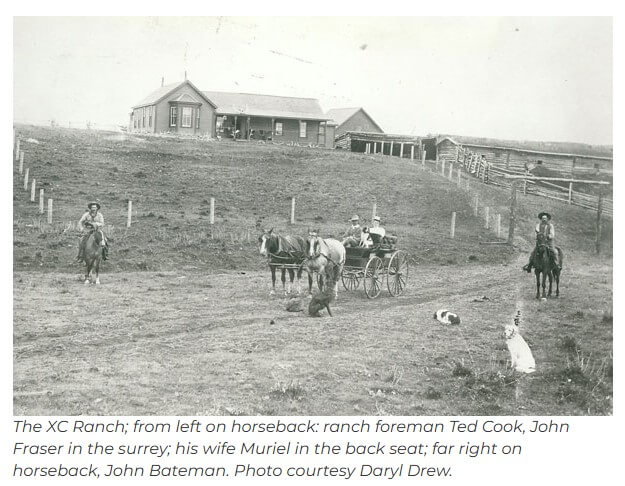
J. A. W. Fraser, affectionately known to his friends as “Jaw”, came to Alberta from Scotland around 1890. He homesteaded the Merino Ranch near Cochrane, later moving to the Jumping Pound, where he purchased between seven and eight sections of land. About that time (1892 or 1893), he dropped his original “JAW” brand in favour of XC. From then on, the Fraser Ranch was known as the XC.
In 1895 Jaw Fraser married Dolly McCreight, and a daughter, Dorothy, was born the following year. Dolly died in 1897, and he married Muriel Winter, (daughter of Judge and Mrs. Winter of Calgary) in 1903. There were two daughters of the second marriage, Daphne and Diana.
Early in his ranching career, Mr. Fraser imported Highland cattle, which however, proved to be unsatisfactory as beef. Later he settled for the more conventional breeds of Angus, Shorthorn and Hereford, always buying the best available breeding stock. Eventually a fine herd of roughly a thousand head was built up. He was a pioneer in the field of vaccination against blackleg.
In 1902 Mr. Fraser imported his first Suffolk Punch stallion, “Lord Nelson”, which he bred to lightweight mares, resulting in a heavyweight hunter type, perfect for driving and a good saddle horse too. Many of these horses were sold to the Royal North West Mounted Police and when World War I broke out, they were in great demand as remounts.
Those were the days when men fought at the drop of a hat, and no saga of the old ranch would be complete without some mention of Ted Cook, an ex-farrier Sergeant of the Boer War, and for many years, foreman of the XC. A big kindly man and a great favorite with all the children, with whom he was patience personified, but if a man angered him, all hell broke loose. On acertain occasion, one of the men was sweet on the current hired girl; it was dinner time and Cook teasingly made some derogatory remark about the girl’s cooking – a heavy cup flew across the table and broke just above Cook’s right eye, – there was a sound of overturning chairs and in seconds a terrified girl was screaming, “Mr. Fraser, Mr. Fraser, come quick, he’s killing my Billy!” With a few well chosen words, the boss quashed Cook, at the same time telling the cupwielding Billy to get his horse and get out fast. Later that day the girl was seen, pitchfork in hand, searching for Cook. She left the next day.
“The Boss”, as he was generally known on the ranch, was Game Warden and Fire Guardian for many years. Fires started by lightning were the most spectacular, turning the forest to the west of the ranch into a raging inferno. In those early days, there were of course no telephones, but somehow every man in the country turned up with wet sacks and salt. A fireguard was promptly ploughed, and eventually the fire was put out. Only then, did weary, red-eyed men and horses (smelling of smoke, with singed hair and eyebrows) head for home. The patient horses stood a short distance from the fire, lines trailing; they too should be remembered.
Fire in the hay meadows was an ever present threat, due to sparks from passing trains and careless humans, endangering the essential winter feed for the stock.
In 1908 Mr. Fraser bought his first car, a McLaughlin Buick. Its weight was tremendous and it had an affinity for mudholes; once stuck, only a very strong team could pull it out, but it was a joy in the dry season to whip into Calgary and back (at 20 mph); a gallon whiskey jar filled with water was carried at all times for the thirsty radiator. If one came home in the dark, the acetylene lamps were lighted with a match. As this was the only car on the Jumping Pound, several optimistic mothers-to-be made use of it to reach Cochrane and Doctor Park, in the nick of time. On one occasion the family drove to Banff. The roads, though dry, were appallingly rough – they had eleven punctures! When eventually they reached Banff, it was 8 p.m. and the gates were closed. In those days no cars were allowed into the town after dark. Their lights would frighten the horses!
Feeding the haying gang posed quite a problem in those non-refrigerator days and to augment the eternal corned beef, which was kept in a barrel of brine in the corner of the cook tent, one sheep a week was killed. Mr. Fraser ran 100 head of Suffolk sheep for this special purpose; he did all the butchering himself and buyers were on hand every fall for the hides.
By 1913 the motor car was becoming increasingly popular, and horses for the family chariot, the democrat, were definitely on the way out, while heavy horses were still in demand. In consequence of this change, the Suffolk Punch stallions were replaced by an imported Clydesdale, “Bog Davey. “
The year 1912 saw the beginning of the now famous Calgary Stampede, and it was decided to import Texas Longhorns as a crowd chiller. Wintering these animals posed a problem and eventually they turned up at the XC, where they added a spectacular feature to the landscape.
Many distinguished visitors stayed at the XC, in those early days when game and fish were plentiful and there were coyote hunts and pigeon shoots.
In the months preceding the first World War, a new type of visitor appeared; the place was alive with geologists, the most noteworthy of whom was Cunningham-Craig, a wily Scot. At that time there was an oil boom in Calgary, to out-boom all oil booms, and according to Cunningham-Craig, the Jumping Pound, and especially the XC, was sitting on top of a sea of oil. We were all going to be millionaires! Mr. Fraser, Mr. Pirmez the Belgian Consul, George Rolls and one or two others formed a company called Petrol Limited, with head office in Belgium. This was July 1914. In August the bubble burst, Belgium was invaded by Germany. We were at war.
In 1916 the XC was sold through a transaction effected by Finney-Wade. The family moved to Vancouver Island, but finding himself unable to settle down there, Mr. Fraser returned to Alberta, where he bought the U bar Cat Pirmez Creek, (now Highland Stock Farm, owned by Mr. and Mrs. Donald Matthews, their son, Rob, his wife and their family). By 1920 he found himself really ready for retirement and, after a trip to Scotland, the family once again headed for Vancouver Island, where they purchased “Culraven,” near Sidney. Here they kept a cow and a couple of horses. Tennis and golf pleasured his leisure time, especially tennis, as he had been an outstanding player in his youth.
Mr. Fraser died in 1930, aged 62 years; his wife followed him in 1963. The XC Ranch is now owned and operated by Frank Copithorne and his three sons, Richard, Ken, and Tom and their families.
Deep Dive
- Merino Ranch
- J.A.W. Fraser Canadian Cowboy Country Article
- Blackleg

So I want to question the statement “he homesteaded the Merino Ranch” ? My great grandfather’s sister Annie Anderson, daughter of Timber Tom Anderson the federal timber agent in Fort Edmonton, married Francis “Frank” White on Oct 20 1885. Frank had been hired as the bookkeeper for Cochrane Ranch and come west in 1882 from Quebec . He left the employ of the Ranch on Dec 19 1884 after a disagreement with its eastern corporate owners. He bought land in Morleyville with James Robertson and built a cabin, moving in his furniture on May 14 1885 with help from Alfred Boyd. He erected fences on north end of lot 8, and brought sheep from Montana. Rev John McDougall petitioned the federal government to assert his rights to build an orphanage there. In the ensuing settlement in May 1886, Frank was granted leases to the former Cochrane Ranch lease land, south of the Bow River and west of Jumping Pound Creek. He drove his sheep south and crossed the railway bridge in July 1886. This was the start of the Merino Ranch which he owned until he sold it in 1901. An article entitled “Sheep breeding in Alberta “-in the Farmer’s Advocate in Oct 20 1893, quite extensively describes his operation, as well as his journal at Glenbow Archives. So I am unsure how Fraser would have homesteaded the Ranch in 1890.