Page 137 More Big Hill Country 2009
Bearspaw School District #3851
On August 8, 1919, the district was established. A three acre portion of the NW Sec 19 Twp 25 Rge 2 WSM that the Morley Trail cut off from the main part of the section, which belonged to A. S. McKay at the time, was chosen as the school location. The parcel of land cost $99 .30. Tenders for construction were sent out and Thomas Cuddie was awarded the contract with an agreement to build the school for $2400.00. School opened August 30, 1920. The first pupils were Stanley, Sidney, Eva and Helen Jonathan, William and Margaret McNeill and Ernest Dickey. The first teacher was Miss Mabel Steeves. During the first years, school continued through July and August and was closed during the two coldest winter months as younger children were too small to ride any distance. Bearspaw school doors remained open until June 1965.
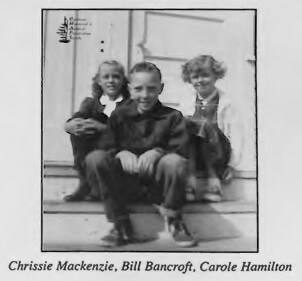
During the years that Richard Bedford (R. B.) Bennett was Member of Parliament for the Bow River Constituency, a scholarship of ten dollars or a gold medal was presented each year to the boy or girl who was the best pupil throughout the school year. It was an important and exciting occasion when Mr. Bennett came to Bearspaw school one year and presented Bob McNeill with a medal. To highlight how important this visit would have been, we recall that R. B. Bennett was Prime Minister of Canada from 1930 to October 1935, when his Conservative party lost the general election to the Liberals led by Mackenzie King.
Beaver Dam School District #1056
Established in 1904, the school was built in 1905 on the N .E. edge of the area covered by this summary of one-roomed schools: South of Madden and north east of Cochrane. Isabel Hughes noted in Big Hill Country that Jesse Havens and Walter McCrimmon were the first teachers. Beaver Dam School was closed in 1978.
Glenbow School District #2303
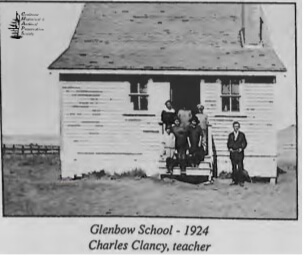
Organization date was October 25, 1910. The school was built at SE Sec 29 Twp 25 Rge 3 W5M, just north of the CPR railway tracks; Thomas Norris was awarded the contract to build the school at a price of $1295.00. Classes actually began in May 1911 – in the stonecutters’ labour hall. The school was not officially opened until March 1912, when Mrs. J. H. Clark of Waverley Ranch did the honours. The town’s main employer, Quinlan-Carter Limited, closed its sandstone quarry in 1912, and other businesses gradually followed. Families moved away; records show Glenbow had a population of fifty in 1914. The school closed from 1915 to 1922 but reopened until 1928. Then, with no children being in attendance and the long-time secretary-treasurer, Mr. J. H. Clark, having died, the school was closed. The schoolhouse was sold to Arthur Norris, who moved it to his farm to make an addition on his house.
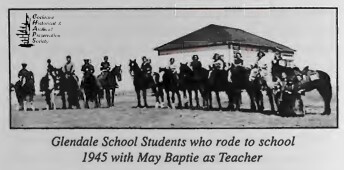
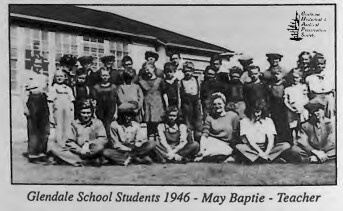
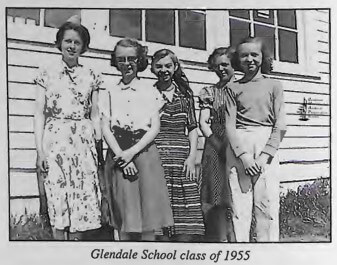
Officially opened December 29, 1910, the school was located at the SW Sec 16 Twp 26 Rge 3 W5M, on land donated by Fred Baker. Glendale opened for classes on the first Monday in January 1911 under the tutorship of an English immigrant Miss Alice Howlett. Glendale was her first school. The first pupils to attend Glendale school were Chauncey and Cecil Coy, Henry O’Hara, Marguerite and Vernon Keeney, Edith and Lena Willis Clara, Matthew. Amy and Mary Coxon, Maggie and Dorothy Standring, Tom Standring and Becky Hector. Elsie Davidson came later from Westminster School District as their school was not open at the time. In 1929, the Glenbow School District joined with Glendale as their school had closed. The ratepayers agreed to the amalgamation and so a second room was added to Glendale at a cost of $4,000.00. The school furnace became overheated on December 6, 1932 and the building caught on fire, completely destroying it and all records. A new school was built on SE Sec 8, Twp 26 Rge 3 W5M land provided by Gordon Cohoe. In 1938 the District became part of the large Calgary Rural School Division #41. In 1960, the school closed its doors as children were being bused to Cochrane schools.
Inglis School District #3433
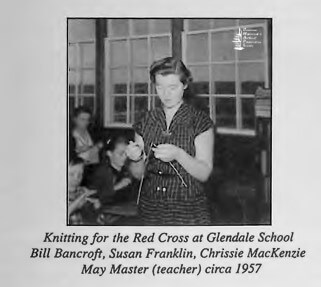
The school was built at the SW Sec 17 Twp 28 Rge 3 W5M along Beaver Dam Creek in 1917. It was the first of the new style of schools that was built in the Cochrane area. Most of one side of the school was windows. Angus McDonald and Ab McCrady were among those who took an active part in the operation of the school, serving as trustees for many years. Named after Captain William M. Inglis, there was never a large enrollment at Inglis and it was closed periodically owing to a lack of students. In the late l 940’s the building was moved to Cochrane and used as an auxiliary classroom. Still later, it was moved to the Cochrane skating rink to be used as a dressing room for several years. Back in the Inglis district, it became necessary to again provide a school for children so the Cochrane Lakes school house (having been formally “closed”) was moved to the Inglis school yard, where it remained open to students for three or four years.
Lochend School District #2732
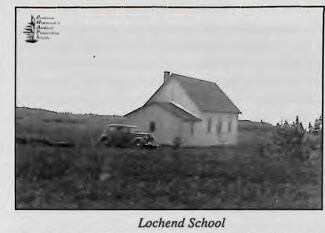
In 1912 the people of the Lochend district asked for, and received, permission to use the Lochend Presbyterian Church for a school. Jo Hutchinson, in Big Hill Country explains that throughout the years, the church was not only used for Sunday services and school but for community entertainment and dances. In 1972 it was sold, to be moved and used as a home some twenty miles northwest in Grand Valley. The building, in its role as a school, remained open from 1912 until the student population declined. It was decided not to hire a teacher in 1920; the school was temporarily closed. Classes were not held until 1945. Miss Ellen Norris (Mrs. Henry Buckler) was hired as the first teacher following the re-opening. Other teachers during the years up until Lochend ‘s permanent closing were: Mrs. E. Lahl, Miss Tucking, Miss R. Cleveland, Mrs. Jones and Miss Sonia Kulyk (Mrs. Bobby Turner).
Summit Hill School District #2003
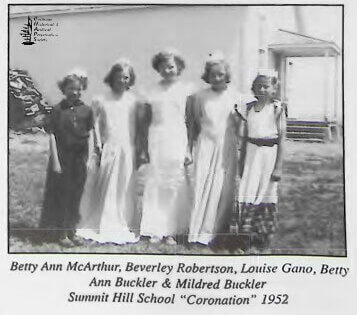
Organized July 8, 1909 and named after a high hill east of Bottrel, the school opened with seven pupils. According to Big Hill Country, over the years, many children attended Summit Hill; 1917 records show 19 pupils and over the period of 1919-1920, about 24 pupils. The Larson family, including six children, arrived in the district in 1911, bumping up school attendance. Some pioneer names of the district were David Buckler, Jim Reeve, Walter Vaughn, Henry Hoffman and Charlie Salsbury. The Hoffmans lived in the Dog Pound School District, but their children attended Summit Hill as Dog Pound S.D. did not have a school. Mr. Hoffman paid school taxes to both districts. His tax to Summit Hill in 1915 was $14.00, paid to Secretary-Treasurer Walter Vaughn. Summit Hill was closed in September 1953 as children were being bused southwest to the Westbrook Consolidated school.
Westminster School District #1848
Organized August 3, 1908, the district’s school was located at Sec 8 Twp 26 Rge 2 W5M. J.C. Nelson was contracted to build the school for $196.00. The building was open for classes in 1912. Louella Thompson was the first teacher; she had four students. In 1930, Miss Lynch had nine students under her supervision. In the early years, the local school was the centre of the community. In the Glendale Women’s Institute’s history, Taming the Prairie Wool we get an idea of a night of socializing amongst the rural Cochrane residents – “Four coal oil lamps with reflector brackets attached to the walls and one hung from the centre of the room provided the light for events such as Christmas concerts, box socials and school meetings”. Often, dance music was provided by an accordion, and on occasion, the popular team of Mr. and Mrs. Milo Martinussen entertained. The dances frequently continued until 7 a.m. In 1949, Westminster with only six students, permanently closed its doors. Jock Stevenson bought the school in 1951 and used it for grain storage.
The 1920 Historic Bearspaw School School District #3851
History 1920 – 1999
In 1919, a group of pioneer farmers decided that they needed a school to educate their children. In 1920, they approached the provincial government and were given the charter and School District 3851. In August 1920, a contract was given to a local contractor for the construction of the Bearspaw School for the sum of $2,400, with a penalty for every day that the job was late.
Desks, blackboards, and other classroom paraphernalia cost a further $432. The Historic Bearspaw School is the last remaining school of the four schools that were built in the farming districts between Calgary and Cochrane, in the early part of the last century. A complete history of the school and the Bearspaw and Glendale Districts are described in the book Taming the Prairie Wool, written by the Bearspaw Glendale Women’s Institute and published in the mid to late 1960’s. In 1936, the school was raised and placed onto a foundation, and a coal fired furnace was installed in the basement. Prior to this time, the school was closed in January and February due to the cold and students made up the time in summer; this was a problem in a farming community.
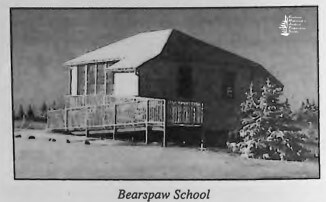
The school was given the name Bearspaw after the name of the section of CPR railway line down by the Bow River, about one mile to the south. “Bearspaw” was the translated name of an Indian Chief at Morley.
For 45 years the school was the most important building in Bearspaw. The school played a major role in the life of the pioneer farmers; it was used as a school, community centre, political meeting hall, place of worship, and for dances. The school allowed families to settle in the area, and so it played a major role in the growth of Bearspaw. One-room schools also show the importance that the pioneers placed on educating their children.
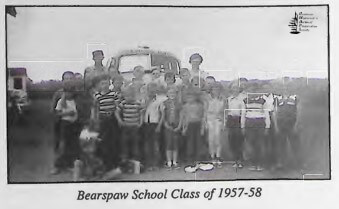
In 1965, the school closed when provincial school boards changed from districts to divisions, and children were bused to the larger schools in Cochrane. In 1967, the school and the land on which it sat were sold to the Bearspaw Lions Club, which owned the adjacent land. In 1998, the Lions decided that they wanted the school removed from their land, so that they could expand their very popular Farmers’ Market, and agreed to donate the school to The Bearspaw Historical Society, provided that the Society moved the school.
The girl’s entrance on the west side of the building was expanded and converted into a barrier free bathroom; a similar bathroom was constructed in the lower level. All the windows were stripped of old paint, reglazed where necessary, and repainted. The old lath and plaster was unfortunately in bad condition and had to be removed. The building was insulated, which it had not been when first constructed, and the inside walls recovered with drywall. Once the inside was completed, the original blackboards were reattached to the walls. The original cupboard was restored by a BHS volunteer as was the original teacher’s desk. The school has a full foundation, as before, but now the lower level is used by a local social services group. The building has been restored to current safety and fire codes for a multi-use public building. Instead of an old gravity, coal-fired furnace in the basement, the school now has high-efficiency furnaces. A new roof was added in the spring of 2005.
In 2000, Carol Pilkington became President of the Bearspaw Historical Society and set about finding a new piece of land onto which to move the school. After reviewing several alternatives, Carol and Valerie Schmaltz, the Administrator at the MD of Rocky View, settled on an ideal piece of land, directly across the road from the Bearspaw Lifestyle Centre and just 50 metres north of the new Bearspaw Public School. In February 2001, the Society was given 1.5 acres of Municipal Reserve #22 by the Municipal District of Rocky View at a Public Hearing, by unanimous agreement of the Councillor.
For the next 12 months, the Society applied for grants, fund raised, hired a restoration consultant and planned the restoration and rehabilitation of the school.
Restoration 2000 – 2004
In the spring of 2002, members of The Bearspaw Historical Society set about cleaning up the outside of the school and removing the graffiti. They stripped off all the old paint and repainted the school, so that it would look presentable in its new location. In June 2002, a contract was given out for the construction of a new basement and parking lot.
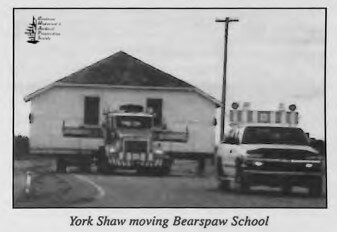
On September 20th, 2002, the historic school was moved to its new location by Shaw Building Movers . Between September 2002 and November 2004, forty volunteers worked on restoring the historic school, both inside and out, to its original condition and to current building codes.
The girl’s entrance on the west side of the building was expanded and converted into a barrier-free bathroom; a similar bathroom was constructed in the lower level. All the windows were stripped of old paint, reglazed where necessary, and repainted. The old lath and plaster was unfortunately in bad condition and had to be removed. The building was insulated, which it had not been when first constructed, and the inside walls recovered with drywall. Once the inside was completed, the original blackboards were reattached to the walls. The original cupboard was restored by a BHS volunteer, as was the original teacher’s desk. The school has a full foundation, as before, but now the lower level is used by a local social services group. The building has been restored to current safety and fire codes for a multi-use public building. Instead of an old gravity, coal-fired furnace in the basement, the school now has high efficiency furnaces. A new roof was added in the spring of 2005.
The school and classroom look exactly as they did from 1936 to 1965, except for the wheelchair ramp, which is now mandatory in a public building of this type. The floors, doors, windows, and blackboards are all original. The classroom is set up with 2 1 old, cast iron desks, a cast iron heater, and all the items that one would expect to find in an old classroom, including a strap. As in the past, the desks are moved next to the walls and the classroom used for meetings, art lessons, exercise groups, birthday and Christmas parties, and weddings. There is a kitchenette in the lower level, accessible to both levels. The lower level and classroom are used mo t day of the week.
In December 2005, the original teacherage was moved back alongside the school. and it has been restored for an office and reading room. The Bearspaw Historical Society ha collected a number of books of local historic interest and these are available to the public for researching family and local history, and their enjoyment.
The Historic Bearspaw School has been preserved as an historic site for the education of the children of Rocky View and Calgary and the enjoyment of the people of Alberta and visitors.
The restoration of the school and teacherage has been possible thanks to the dedication of the members of The Bearspaw Historical Society and other volunteers who spent over 4,000 hours working on the project. Grants were obtained from the MD of Rocky View Cash in Lieu Grants and a Centennial Grant, the Alberta Provincial Government Community and Facility Enhancement Program and the Alberta Gaming and Liquor Commission, the Calgary Foundation and the Cochrane and District Foundation. Donations of cash and materials were also received from 32 individuals and businesses. The school has been designated a Municipal Historic Resource by the MD of Rocky View #44.
Current Uses of the School
The school’s lower level is being used as an office by a community social worker. Artists and musicians use the classroom for lessons, and community groups for meetings. School children enjoy visiting the school to experience the historic classroom. The classroom has also been used as a polling station by the MD of Rocky View #44, by dance groups and book clubs, plus private and company parties.
Deep Dive
- R.B. Bennett
- Quilan-Carter Limited
- Chief Bearspaw – Bearspaw First Nation
